Robot Ethics by Patrick Lin Keith Abney George A. Bekey
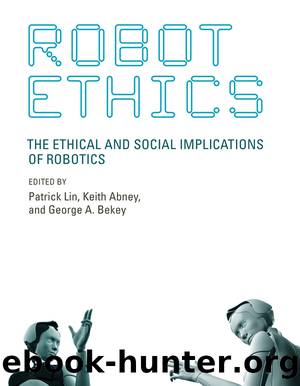
Author:Patrick Lin, Keith Abney, George A. Bekey [Patrick Lin, Keith Abney, George A. Bekey]
Language: eng
Format: epub
ISBN: 9780262297752
Publisher: MIT Press
Published: 2012-07-15T05:00:00+00:00
V
Psychology and Sex
The anthropomorphization of robots is an important trend, not merely for the privacy implications noted in chapter 12, but also for increasing public acceptance, even affinity, toward robots. But this betides a new danger of âtoo much of a good thingâ: Can one become emotionally over-invested in robots? Are there potential harms due to emotional and psychic dependence that raise serious moral concerns, either to the human users of robots or to the public at large?
Matthias Scheutz discusses the dangers of emotional bonds with robots in chapter 13; he argues that social robots will differ from industrial or military robots in appearance, environment, programming, mobility, autonomy, and perceived agency. As humans have a tendency to personify and become emotionally dependent on social robots, opportunities will abound for malicious exploitation of such unidirectional emotional bonds by the creators or purveyors of robots. Scheutz recommends regulations to forestall such worries, including the possibility of creating robots with emotions of their own.
David Levy in chapter 14 and Blay Whitby in chapter 15 investigate aspects of one of the most notorious, widely publicized, and most intense types of psychological and emotional experiences humans will have with robots: sex.
Levyâs chapter focuses on the idea that robot prostitutes, or âsexbots,â will soon become widely accepted alternatives to human sex workers, and he takes up five aspects of the ethics of robot prostitution. He considers the ethical issues concerning the general use of robot prostitutes, effects on an individualâs self-respect in using a robot in this way, how such use affects other human intimate relationships (e.g., is it infidelity?), and the impact of robotic prostitutes on human sex workers and (eventually) on the sexbots themselves.
Whitby examines robot lovers within the general context of the ethics of caring technologies. In Japan and South Korea, robots are widely assumed to have a future significant role in elder care and babysitting. But wishful thinking and hype can obscure both what is actually possible, and what shouldâor should notâbe allowed. Whitby notes that Masahiro Moriâs hypothesis of the âUncanny Valleyâ poses a difficult technical barrier to creating realistic-looking robot lovers, but robots may soon be able to better human companionsâ ability to retain intimate knowledge of oneâs own quirks, and respond to (and even anticipate) oneâs feelings. He notes people unable to find lovers, or prevented from doing so (e.g., criminals), are obvious markets for robotic companions, but notes a disquieting further possibility: people may seek robots in order to do things to them that would be abhorrent when done to another human. As such, he considers the possibility of love for (or by) a robot, and reflects on Levyâs arguments. He ends with a call for public discussion and the possible development of professional ethics codes to guide the responsible development of robotic companions. Then, in part VI, we focus on the broader notion of robots as caregivers.
Download
This site does not store any files on its server. We only index and link to content provided by other sites. Please contact the content providers to delete copyright contents if any and email us, we'll remove relevant links or contents immediately.
Whiskies Galore by Ian Buxton(42078)
Introduction to Aircraft Design (Cambridge Aerospace Series) by John P. Fielding(33175)
Small Unmanned Fixed-wing Aircraft Design by Andrew J. Keane Andras Sobester James P. Scanlan & András Sóbester & James P. Scanlan(32835)
Aircraft Design of WWII: A Sketchbook by Lockheed Aircraft Corporation(32329)
Craft Beer for the Homebrewer by Michael Agnew(18284)
Turbulence by E. J. Noyes(8112)
The Complete Stick Figure Physics Tutorials by Allen Sarah(7422)
The Institute by Stephen King(7088)
The Thirst by Nesbo Jo(7002)
Kaplan MCAT General Chemistry Review by Kaplan(6986)
Bad Blood by John Carreyrou(6669)
Modelling of Convective Heat and Mass Transfer in Rotating Flows by Igor V. Shevchuk(6495)
Weapons of Math Destruction by Cathy O'Neil(6362)
Learning SQL by Alan Beaulieu(6343)
Man-made Catastrophes and Risk Information Concealment by Dmitry Chernov & Didier Sornette(6138)
Permanent Record by Edward Snowden(5890)
Digital Minimalism by Cal Newport;(5835)
Life 3.0: Being Human in the Age of Artificial Intelligence by Tegmark Max(5616)
iGen by Jean M. Twenge(5453)
